
Our approach
Our approach
Too many children are missing the foundations they need to thrive
Too many children reach the age of five without the foundations they need to thrive. These inequalities are deep, long-lasting and deeply unfair.
The experiences and relationships children have from pregnancy to five shape every aspect of their development. Parents and carers play a critical role, but too often families don’t get the right support at the right time because services aren’t working effectively together.
Evidence shows that when services collaborate, children’s developmental, health and educational outcomes improve, with benefits that last well beyond the early years.
Real change requires families, communities and services working in partnership to give every child the best possible start in life.
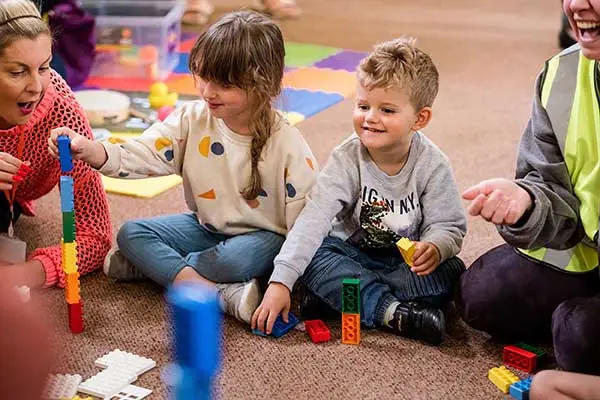
In some of the communities where we work, around half of children do not reach a Good Level of Development at age five.
A joined-up approach, at every level
Central expertise and support
A central team, which includes in-house data and insight expertise, supports local backbone teams in our programme areas and co-ordinates cross-programme working on key areas.
Additional support is provided by our Advisory Council and Evaluation Advisory Group, made up of some of the leading thinkers and practitioners in early years.
Local backbone teams
The local backbone teams, headed by programme directors who bring senior level expertise from early years, education or policy, include education, health and outreach leads.
They build relationships on the ground and bring together partners to strengthen workforce practice, parent engagement, use of data and cross-sector collaboration, creating the conditions for sustained improvement.
They also support evidence-based interventions to be delivered well, consistently and at scale.
Parent Connectors
Parents, carers and communities are at the heart of everything we do. Our locally recruited parent connectors build trust with families, strengthen peer networks and improve engagement, ensuring families feel supported, heard and connected to the right help at the right time.
We know that the quality of relationships between families and services makes a significant difference to whether support is accessed and whether it works. That’s why we focus not just on what support is available, but on how it is designed, delivered and experienced by the people it’s meant to reach.
Where we work


A systems approach to lasting change
Stronger foundations for life and learning
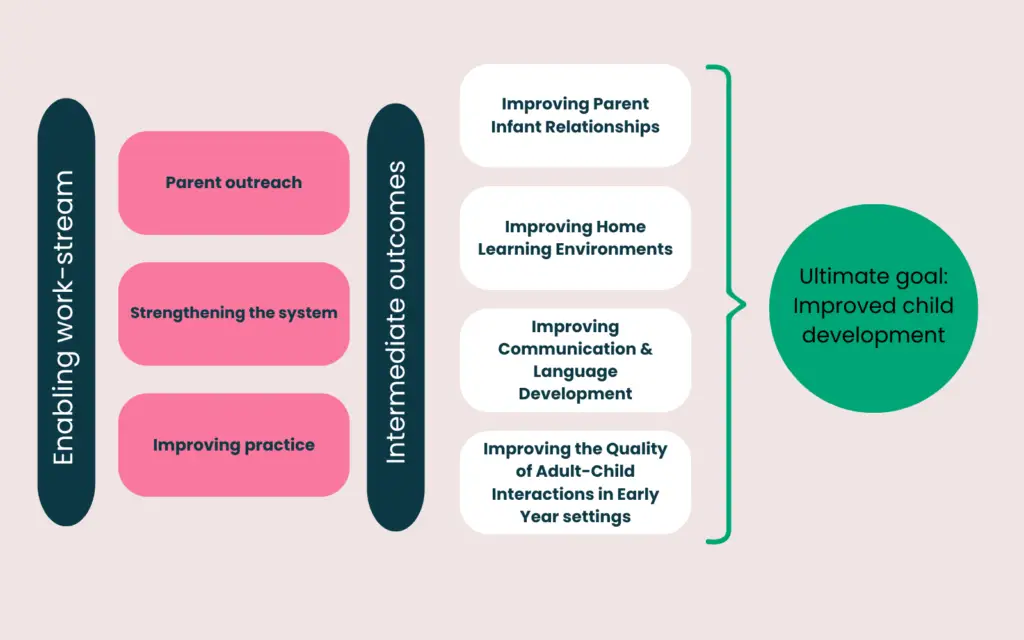
Everything we do is to ensure all children in their early years have the strong foundations they need for life and learning. Our approach is intended to deliver sustained improvement in children’s developmental outcomes.
In England this means an increased proportion of children reaching a Good Level of Development (GLD) at age five in each programme area. In Scotland, we look for improvements to healthy child development data from the 27-30 month and 4-5 year reviews, alongside Achievement of Curriculum for Excellence Levels in literacy and numeracy.
We work in communities facing hardship where too many children do not yet have the support they need to thrive.
A place-based approach, developed in three phases
What this looks like in practice depends on the best evidence about child development and improving our target outcomes, and on the specific local context in the places where we work.
Our place-based approach develops across three phases.
01
Discover
Mapping existing support services and assets, along with the views of all those in the community including parents and carers, and those working in the early years system.
02
Co-design and implement
03
Improve and embed
Evidence, Evaluation and Data
A strong focus on data, evidence and evaluation underpins everything we do. We draw on the latest research and best practice from across the early years sector to strengthen our approach. We work with local partners to analyse need, monitor progress and use insight to continuously improve how support for children and families is designed and delivered. We measure what works, and how well we have delivered our work – including assessing its long-term sustainability.
Our approach is independently evaluated by the Centre for Evidence and Implementation, with support from the Nuffield Foundation.
Working with another independent partner, ISOS Partnership, we capture what works from our programmes to develop our ‘playbook’. This enables us to share learning across sites while maintaining flexibility for local context.
Funding
Discover more about our approach
See our approach in action
Our impact
Partner with us
Find out how we work with funders, organisations and local partners to create lasting change.