



There were three big reasons why I wanted to become a trustee for Thrive at Five.
Firstly, the urgent focus on improving young children’s life chances.
The first five years of a child’s life can seem to fly by, yet they can have a huge impact on the rest of their life.
For example, as the Early Intervention Foundation report, children with poor vocabulary skills at age 5 are more likely to:
- have difficulties learning to read
- experience unemployment and mental health problems as adults
As a result, they argue that “allowing less well-off children to fall behind in their language development risks undermining their life chances and perpetuating a cycle of disadvantage and poverty” (Law and others, 2017).
Secondly, I admired Thrive at Five’s focus on community participation.
I’d spent two decades leading Sure Start local programmes and Children’s Centres, and I’d seen how well local programmes can work when they are shaped with parents and carers. I was immediately excited by the innovative ways that Thrive at Five works.
The third reason was Thrive at Five’s focus on evidence-based practice.
I’d seen over the years that Sure Start leaders, like me, could get swept along. We could end up offering programmes and services because they looked attractive, or fun, or because the centre up the road was doing them and we didn’t want to get left behind. As resources shrank, it became ever more important to spend money well and make a difference. Using research evidence to aid my decision-making seemed the best way forward.
Starting with communities, not programmes
In this blog, I want to focus on that third priority: putting research evidence into action.
We’ve got a lot more research evidence now about what works – and what doesn’t – compared to those first days of developing Children’s Centres in the late 1990s and early 2000s. Thrive at Five is committed to using robust research evidence to make a difference to children’s lives. That takes us forward as a sector. We can deepen our learning about programmes that have positive overall evaluations, by seeing how they work in the specific neighbourhoods that Thrive at Five is reaching.
But, I’d like to make a brief point first about parent involvement and co-design.
If we’re going to try to improve the experiences and life-chances of families in under-served neighbourhoods, we need to hear about and learn from the lived experiences of the people there. The era of ‘doing to’ needs to come to an end. To make life-chances more equal, we need to take action by standing alongside communities: ‘doing with’.
The Fun Boy Three principle: it ain’t what you do, it’s the way that you do it

Older readers of this blog might remember the band Fun Boy Three, who teamed up with Bananarama and had a big hit with ‘It ain’t what you do, it’s the way that you do it’.
When it comes to using research evidence, ‘the way that you do it’ is crucial.
In its early days, Thrive at Five chose to implement one of the best-researched and positive interventions to improve young children’s language and communication. It’s called the Nuffield Early Language Intervention (NELI).
What the evidence says about NELI
Tens of thousands of children have benefited from NELI: the outcomes are impressive. A large-scale impact evaluation by the Education Endowment Foundation (EEF) found that:
- children who received NELI made the equivalent of four additional months’ progress in language skills, on average, compared to children who did not take part in the programmes
- children learning English as an Additional Language equally benefited from the programme
- children eligible for Free School Meals made additional progress of on average seven months
So, it’s simple? You just take NELI off the shelf and put it to work in Thrive at Five neighbourhoods, and that makes a big difference to children’s language development?
The answer to that question is tricky: yes, and no.
It’s positive that we have strong evidence behind NELI. Resources and time are short. Children aren’t in the early years for long. We need to act quickly to help them develop as well as possible. NELI is a good action to take.
Putting it into practice isn’t straightforward
In truth, however, it isn’t easy to do new or extra things in schools.
Schools are busy places, juggling many different priorities. To do something additional, a school may need to make a hard choice about stopping something else.
That’s why it’s so positive that Thrive at Five offers schools additional resources to deliver NELI, including extra staffing to run the sessions (trained student volunteers from Staffordshire University).
We know that schools really value this extra help. For example, one Reception teacher commented that ‘without the support of Thrive at Five, we would have really struggled. The sessions take the Teaching Assistant out of the classroom for long periods, which is challenging given the increasing needs of the children. Having that extra support was an absolute godsend.’
Yet despite this extra input, it was still hard for schools to deliver the full programme in Stoke reception classes.
Data from Thrive at Five tells us that NELI was only partially implemented across all schools: none of them was able to deliver the full 20-week programme.
All the schools, however, completed Phase 1 (10 weeks) and 6 schools completed over 60% of sessions.
What happened in Stoke
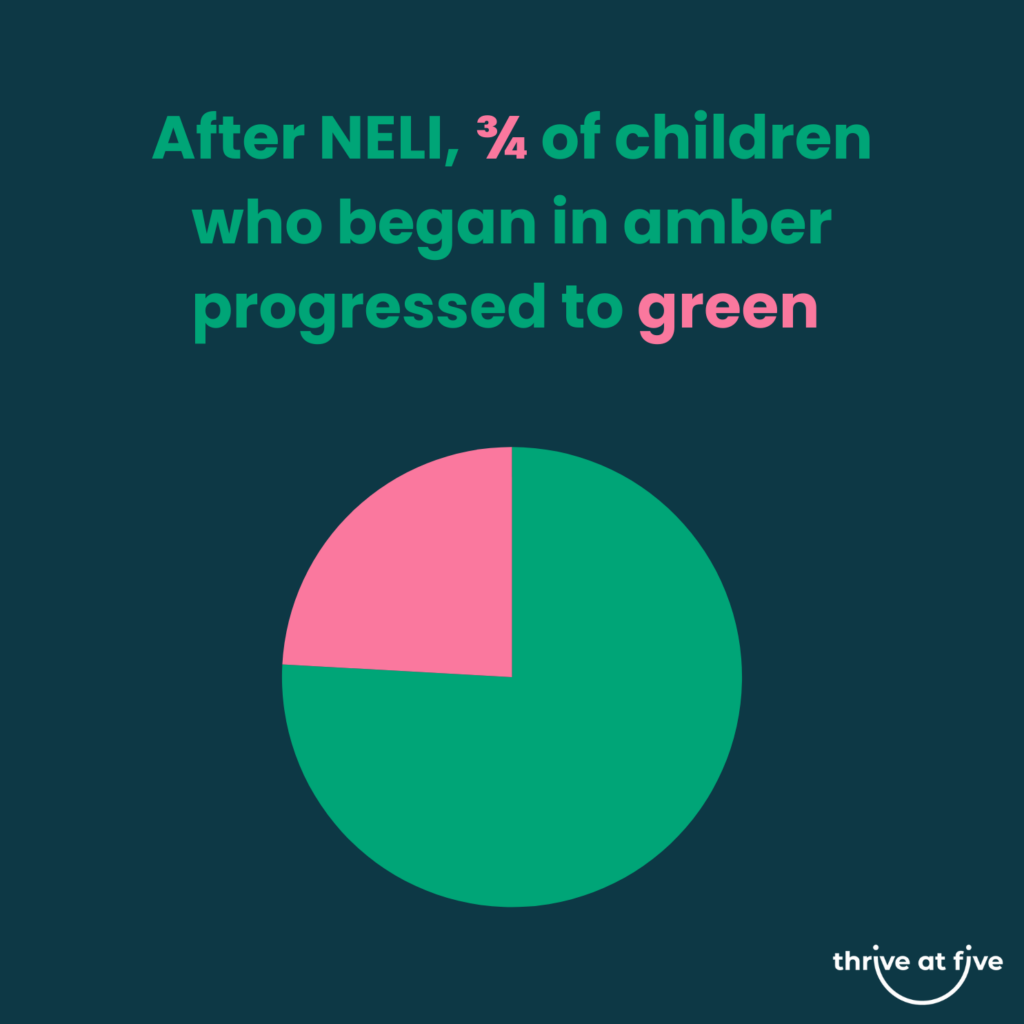
Despite the challenges of implementation, the outcomes in Stoke are impressive. In 2024, for example, at the start of the Reception year only 3% of the children involved had language skills that were ‘not a cause for concern’.
By the end of the year, the proportion of children with language skills not causing concern had increased substantially to 65%.
Language and communication are important in their own right. But, additionally, the EEF comment that ‘language provides the foundation of thinking and learning and should be prioritised.’
So did NELI boost children’s thinking and learning as well as their language?
The answer is yes. Children eligible for Free School Meals in Stoke whose schools are part of Thrive at Five are now much more likely to be doing well by the end of the Reception year. Between 2024 and 2025, the proportion of children achieving a ‘Good Level of Development’ (using the Early Years Foundation Stage Profile as a measure) increased from 52.8% to 64.2%. Whilst we have to be careful about comparing two quite small groups of children (a cohort of 125 children eligible for Free School Meals in 2024, compared to a cohort of 109 in 2025) these are nevertheless very promising outcomes.
That’s why I have never regretted becoming a trustee of Thrive at Five and playing a small role in its work.
The experience has also convinced me that we need to feel confident about the ‘messiness’ when we put research evidence into action. Working with communities, schools and families is never going to be straightforward. Programmes for children and families aren’t simple – and that’s not a reason to shy away from the evidence, but to engage with it more carefully.
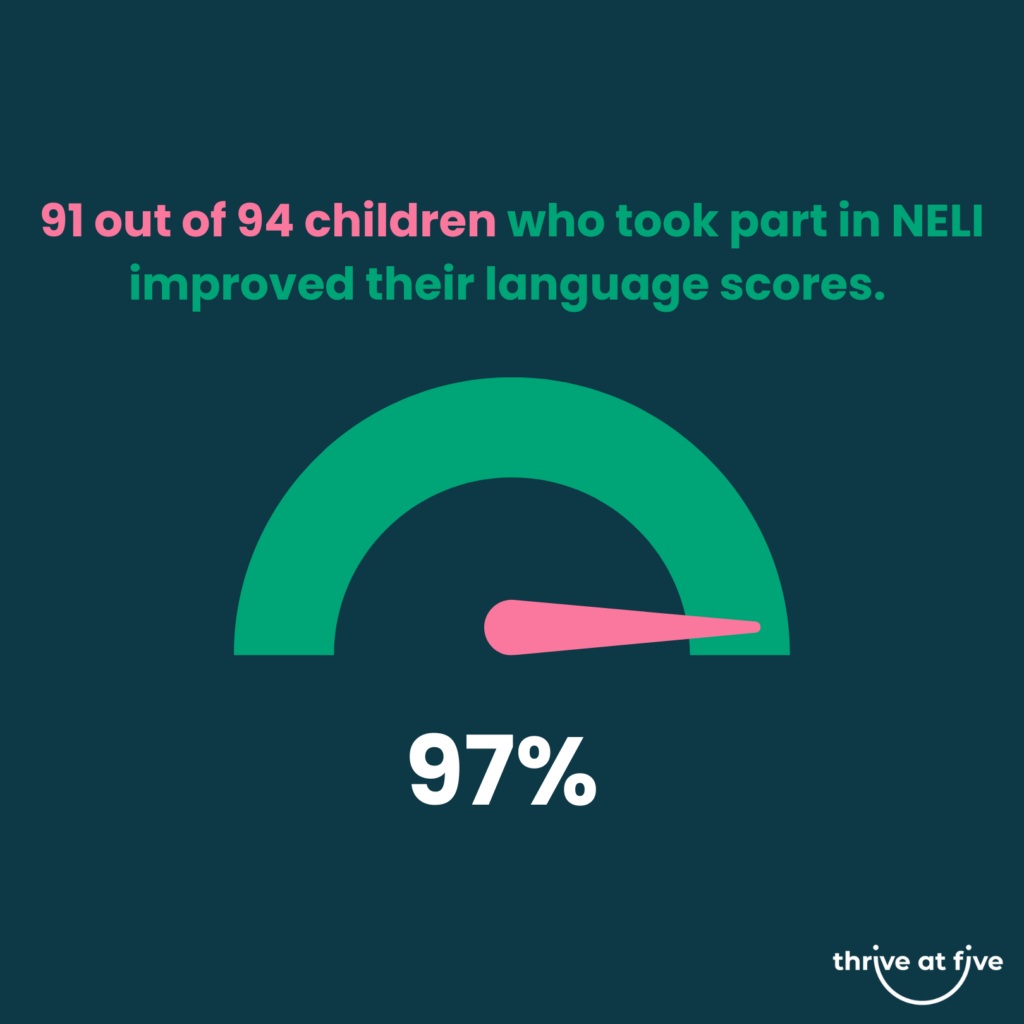
Three things I’d take away
1. Research evidence helped Thrive at Five to make ‘best bets’ – choose approaches, like NELI, which are well-evidenced and therefore highly likely to make a positive difference to the children involved
2. Even when ‘best bets’ are thoughtfully selected, and care is given to support schools, it is still very difficult to put a new approach into action. None of the schools was able to deliver the whole of the NELI programmes
3. So, we still need to keep learning more about barriers to implementation: how we can help schools to put new approaches into action, and how we might inform the design of new approaches to make sure they don’t stretch staffing, time and other resources too thinly in busy schools.