


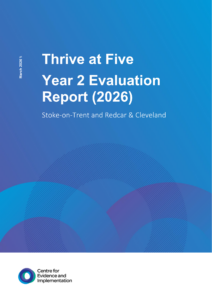
 Our latest independent evaluation highlights how Thrive at Five is continuing to strengthen early years systems and improve outcomes for children by working in a way that is grounded in evidence, evaluation and learning.
The report outlines findings from the second year of the independent evaluation by the Centre for Evidence and Implementation, and supported by the Nuffield Foundation.
It evaluates Thrive at Five in Stoke-on-Trent and Redcar & Cleveland.
A key insight is that many of the same challenges emerge across different areas, including how services work together, how parents are engaged and supported, and how data is used to guide decisions. Our approach is designed to respond to these, combining a strong focus on parent engagement, evidence and data, and more joined up ways of working across services and communities.
While this is taking shape in different ways locally, the core of the approach remains consistent: bringing together locally rooted backbone teams and central expertise to support strong implementation, better decision making and improved outcomes for children and families.
About the evaluation report
This report presents findings from the second year of the independent evaluation of Thrive at Five, undertaken by the Centre for Evidence and Implementation. It covers the second year of implementation in Stoke-on-Trent and the first year in Redcar & Cleveland, examining implementation progress, facilitators and barriers, and early evidence of impact.
Evidence is drawn from qualitative interviews with senior leaders, workforce partners, practitioners, parents and backbone team staff, alongside workforce surveys, data benchmarking on intermediate outcomes in Stoke-on-Trent, and internal programme evaluation.
Findings
The report states: Across both sites, Thrive at Five demonstrates strong credibility, high acceptability, and clear potential to drive system-level change. The programme is well positioned to move into a more ambitious phase, which focuses on strengthening system ownership, clarifying governance arrangements, articulating enabling workstreams more clearly, being more explicit in modelling of ways of working, and including more parents and communities in decision-making and governance.
This project has been funded by the Nuffield Foundation, but the views expressed are those of the authors and not necessarily the Foundation. Visit nuffieldfoundation.org